
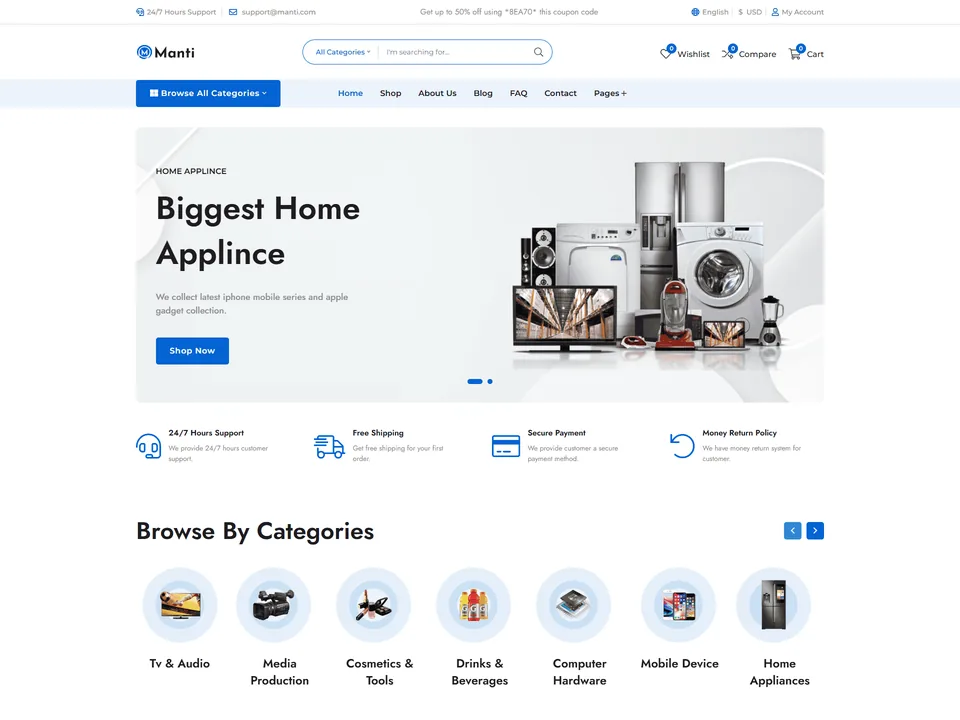
There is a moment in every commerce project where someone says the words “new theme” and the room quietly assumes a migration. Products get exported, orders get frozen, the team plans a launch window. It does not have to work that way.
The storefront is a layer
A storefront is a presentation of a catalog, not a copy of it. Once that distinction is real in the architecture, changing how a product looks becomes a design task rather than an infrastructure project.
In our commerce engine, content, pricing, inventory and orders live behind a stable API. A theme consumes that API. It can be opinionated about layout, typography and interaction, but it cannot quietly invent its own product model.
“If switching a theme requires touching an order, the theme was never a theme.”
One engine, many personalities
We run several very different storefronts on the same engine: a multipurpose catalog, a focused single-product shop, a marketplace-style layout. They share checkout, order management, payments and fulfillment. They do not share a visual language.
- Shared: catalog, cart, checkout, payments, inventory, order history, admin tooling.
- Per theme: information architecture, layout, typography, imagery, motion, editorial voice.
- Never shared: business rules hidden inside templates. Those belong in the engine.
That split is what makes a theme swap boring in the best way. The risky parts of commerce keep running while the visible part changes.
The theme contract
A theme is only safely swappable if it knows what it is allowed to ask for. We keep a small contract: typed content blocks, reusable product and collection components, and a defined set of slots for editorial sections.
When a brand needs something the contract does not cover, we extend the contract deliberately. We do not let one storefront reach into the database because it is faster this afternoon. That shortcut always becomes the reason the next change is expensive.
Ask whether you could launch a seasonal storefront without a deploy that touches checkout. If the answer is no, the storefront and the commerce engine are still too entangled.
What it buys a brand
The obvious benefit is cheaper redesigns. The less obvious one is confidence. Teams try more things when a visual change carries no operational risk. Seasonal campaigns, new collections and experimental landing pages stop competing with the roadmap for engineering time.
A theme engine is not a feature customers see. It is the reason the visible product can keep changing without the business holding its breath.